$0.00
What we can learn from Jesus about temptation

 The lion circled, but Jesus didn’t notice. He was on his knees, lost in prayer, only his lips moving. The sun beat down without mercy, the wind whipped the desert sand – there was no protection from the elements. This was his 40th day without food, and the fast had stripped his body of strength. He did not look like himself. His skin stretched like shrink-wrap over a thin, skeletal frame. His once strong muscles were withered to a fraction of their size. His ribs protruded from his sides. His fingers were bony. Blisters and sores had broken out on the surface of his skin – the final expression of his malnourished state.
But while his body was unrecognizable, his spirit had developed a strong sense of dependence on his Father. It was as if the strength he now lacked in his physical body had been transferred to his spirit.
The flesh and blood lion still circled, but that was the least of his worries. There was something else stalking him now; a lion of a different kind.
Jesus heard the words before he saw the shape. “If you are the Son of God, command this stone to become bread.” Those words elicited his strongest hunger pains yet. His stomach insisted. His body quivered for lack of strength. The memory of his mother’s baking wafted up from the desert floor. The nerve endings in his fingertips sprung to life and fired the message: The stone beneath your hand feels like a loaf of bread. Just say the word.
He paused briefly before he spoke. Remembering Eve’s failure with the deceiver, he didn’t want to engage a conversation; he wanted to parry with truth. His mind chased down the Biblical narratives he’d learned as a child. He was looking for parallels to his situation.
The wilderness. The desires of his people. The nagging hunger pains. He had the story. He could see the letters on the scroll. His mind raced to the final verse. He opened his mouth and spoke. “It is written, ‘Man shall not live by bread alone.’”
The written Word had authority. It emptied the deception of its power. In a moment the mirage of his mother’s oven was gone. His hunger subsided. And his fingertips told him the truth: The stone beneath your hand feels like . . . a stone.
The deceiver couldn’t argue. Still, he continued to circle. Perhaps he could change the subject.
Jesus knew the Word well. He could pull out an obscure Bible passage, explain its meaning, and the people would stand amazed. When tempted by Satan, he answered with Scriptures that he had carefully considered and properly applied. When others had a need, Jesus listened well and had the right passage to share.
Because he operated within the intrinsic limitations of humanity, he acquired his skill with the Word through learning. The Bible declares that he grew in wisdom and favor with God. Like all young Jewish boys, he would have memorized a significant portion of the Scripture. To gain such knowledge, Jesus studied, learned, memorized, and applied. Do we bring the same kind of diligent study to the Word that Jesus brought?
Taken from Just Like Jesus: biblical strategies for growing well
All Biblical Strategies resources are available at Amazon.com. Click here for a complete listing of our resources. Or visit our website biblicalstrategies.com

 Lie #1: It’s your time. You should be able to use it as you desire.
 Lie #5: This task is too difficult for you. Wait until it’s easier.
 Nearly 25 years ago, I moved to New Jersey to pastor a congregation that had begun a few years earlier. Before accepting the call, I’d preached a handful of messages, but had never performed a baptism, funeral, or wedding. I’m grateful the congregation was understanding with such a newbie. I bumped a man’s head on the baptismal tank, bumbled a funeral or two, and once forgot to have the groom kiss the bride (she reminded me of course). When I look back there are a number of things I would have done differently, but one thing I’m forever grateful that I did do was to consistently meet with a small group of men. After three years of doing it alone, I could feel the dangers of isolationism settling in. So I made a decision to start meeting with men. Over the years, the men have aged, the names have changed, and even some of the diners have closed, but the meetings have remained persistent.

 One of the common themes I’ve observed as a pastor is that people often fail to do what they should do, because they’re trying to do what only God can do. We are not equipped to carry out God’s role, but that doesn’t keep us from trying. Here are some examples:
 This past weekend I had the privilege of giving my daughter away at a picture-perfect wedding outside of a reconstructed barn at the base of the Allegheny Mountains. For a father, giving your daughter away is a bit like taking your emotions and dangling them over a deep, dark abyss for the day. You can’t see the bottom of the chasm, and you’re afraid that if you start descending down there you won’t make it back before the wedding is over. The sense of loss is also mingled with great joy for their happiness as they start their life together. Here are a few of the thoughts I shared with my daughter and son-in-law on that day. They serve as helpful reminders for all of us regardless of how long we’ve been married.


 When Adam and Eve partook of the forbidden fruit, they could not possibly have envisioned what they would unleash on humankind. Death comes in many forms: famine, war, disease, and murder. But their choice also brought a similar disaster to the development of our relationships with each other. Frederick Buecher writes,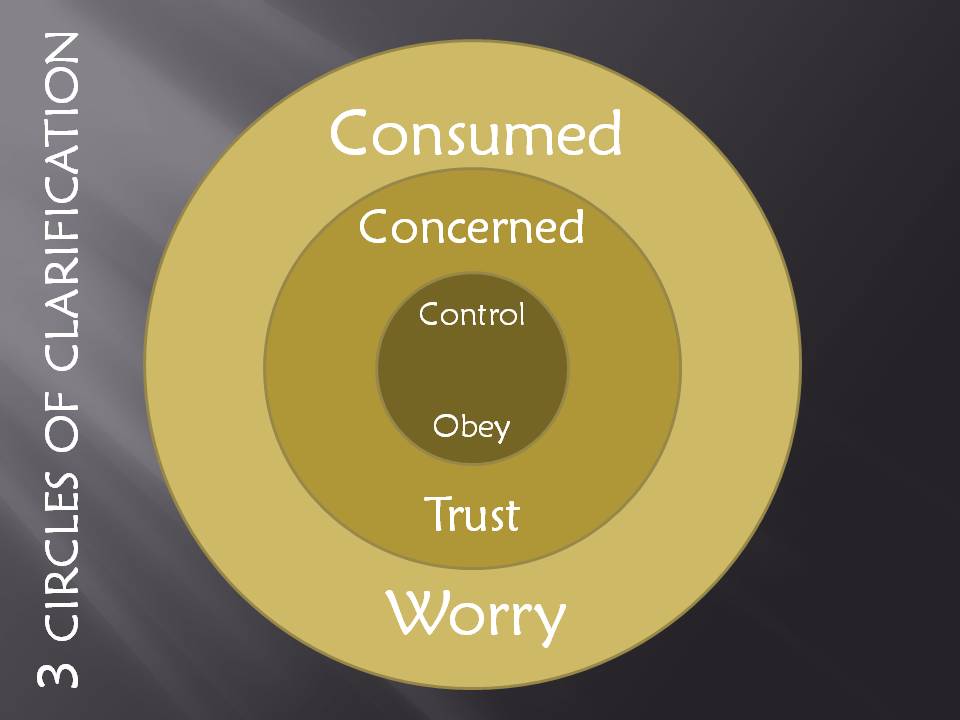
 Have you ever struggled with feelings of anxiety and said, “I just feel like everything is out of control?” Chances are your worry is a result of the things that are not simply out of control, but outside of your control. Three circles will bring clarification to how you perceive your circumstances and what you can actually do about it.
 When we’re anxious, it’s hard to be still. We think if we work harder relief from the anxiety will come. But we accomplish one task, only to grow anxious about another. We run faster, only to discover our anxious thoughts were waiting of us at the next destination. We cannot outwork nor outrun our anxious thoughts. This prompted King David to write: “Be still before the Lord and wait patiently on him” (Ps. 37:7). Later in the Psalms God speaks in the first person: “Be still and know that I am God. I will be exalted among the nations, I will be exalted in the earth” (Ps. 46:10). The Bible ties our ability to be still and wait to what God has done and will do.
 Taken from Safe in the Storm: biblical strategies of overcoming anxiety
 The world that you and I pass through daily is fraught with spiritual challenges. In our mundane day-to-day existence, it’s easy to forget that. A friend of mine shared recently that there are five D’s that Satan uses to attack us. The five words are: doubt, discouragement, diversion, defeat and delay. Here they are with brief definitions, and a few of my insights.