
$0.00
Seeing Self-Pity as a Dead-End Road

 Several years ago the road I traveled home at the end of the day was washed out in one of those torrential rains that come around every hundred years. For nearly ten years this had been my route home, but now there was a barrier placed at the half way point. My habitual commute ended with a dead-end. It took them two years to repair that road. For two years my commute included an extra five miles nearly every day, because I kept forgetting the road was out until I saw the barricade. I’d turn around and drive out the same way I’d come in, telling myself that I wouldn’t make the same mistake tomorrow.
My route home during that time parallels my struggle with self-pity. Even though I know it is a road leading nowhere, I instinctively choose it as if I have no other option. Self-pity is best defined as the preoccupation with yourself because your hopes, desires, or expectations have not been realized. It is unproductive and destructive to all relationships. From time to time, I still find myself on that all-too-familiar road, unable to remember how I got there until I see that barricade and realize I’m approaching self-pity’s dead-end.
In the Scriptures we discover God’s thoughts on self-pity through his conversations with biblical characters. Three in particular are worth noting: Cain, Moses, and Jonah. Each encounter reveals God’s warnings for those on the dead-end road of self-pity. They also provide God’s gracious solutions for how to return to a life of productivity. A careful study of the biblical characters reveals several common features in their battles with self-pity:
- It followed a mountain-top experience
- It revealed a prideful desire for another’s approval
- It intensified when they ran from responsibility
- It grew in the discontented heart
- It increased when they compared themselves to others
- It fueled various forms of anger
- It led to despair
While some of the features were similar, there were marked differences in the final outcomes. Moses was successful at defeating self-pity and went on to live a productive life. Cain and Jonah were not; they simply would not stop thinking about themselves.
Self-pity is sometimes mistaken for humility, but it is actually a prideful response, even though it may not feel that way to us or appear that way to others. C.S. Lewis shows us the nature of genuine humility when he writes, “True humility is not thinking less of yourself, it is thinking of yourself less.” Like the facade on a rotting structure, self-pity is a false humility. True humility is so sharply focused on others that it will sacrifice itself completely for another.
This is clearly the pattern Jesus demonstrated for us. When the disciples were arguing about who should be the greatest, Jesus saw it as an opportunity to talk about the cross. He says, “For even the Son of Man came not to be served, but to serve and to give his life a ransom for many.” Jesus encourages us to do the same.
While the Father teaches us how to think, and the Son exemplifies for us what to do, it is the Holy Spirit’s power that actually makes change possible. He empowers us to make God-honoring choices. As we cooperate with him, those daily choices will become daily habits, and lasting change will follow. This is what it means to walk in the Spirit.
Perhaps you know self-pity firsthand. Your circumstances seem overwhelming. Negative thoughts consume your thinking. Feeling sorry for yourself has become a way of life. While you used to battle temptation, lately you can’t find the energy to try. You compare yourself to others and come up short. No matter where you start, all roads seem to lead to self-pity’s dead-end. Perhaps its time to get you off a road that leads nowhere and to get you back on the road God wants for you.
Because self-pity tends to be a struggle for many men, we include a session on it in our 4M Training for Men.
Taken from Dead-End Desire: biblical strategies for overcoming self-pity

 My dentist warned me, but I didn’t listen. “A temporary crown,” he said, “is only temporary. Make an appointment to see me in about 30 days; by that time your permanent crown will be ready and we’ll make sure we protect that root canal.” I scheduled my next visit, but a severe storm closed the office the day of the appointment. They called and left several messages, but when you’ve developed the habit of procrastination, it’s pretty easy to not return a call from the dentist. Life got busy, and I forgot his warning. Months passed—18 to be exact. When I finally scheduled the appointment, the news wasn’t good. “A temporary crown can’t protect the tooth from decay, like a permanent one can. Decay has begun, and the situation has been compromised. I can do my best to attach the permanent crown, but at some point this tooth will need to be extracted.” I must have looked confused because he added, “The reason you didn’t feel the effects of the decay, was that we removed the nerve when we did the root canal.” While my dentist felt bad, it wasn’t his fault. My tendency to procrastinate made me responsible. I should have known better.
 Victor Kiam, CEO of Remington, gave us five words that reveal procrastination’s great danger:
 On the night before Jesus died, he informed his disciples that he would shortly be leaving.
 Procrastination is a man-made defense in response to fear. Perhaps you haven’t stated it that boldly yet, but whether you’re putting off a difficult project or a potential confrontation, there’s a good chance you’re afraid. Jesus reveals this truth when he tells the story of the three stewards. A steward is one who is given charge over certain assets by his master. He is not the owner of those assets, nor has he earned them. In the story, each steward was given responsibility for a sum of money that they were to invest wisely. In Jesus’ parable each steward was entrusted with certain talents by their master. The word talent describes the value of the assets with which they were entrusted. The three stewards were given 5 talents, 2 talents, and 1 talent respectively. In biblical language, a talent was a financial measurement and could be valued in silver or gold. A talent of silver was worth approximately $384,000 in modern US dollars; a talent of gold about $5,760,000. By the gold standard, the first was entrusted with 29 million dollars, the second 11.5 million dollars, and the third 5.75 million dollars. That’s a lot of somebody else’s money to be responsible for.
 A friend of mine challenged me with a great question. He asked, “If Christmas is Jesus’ birthday why is it we spend all our time hunting for gifts to give to others?” He paused and added thoughtfully, “It would be a little like your friends insisting they help you celebrate your birthday, and then they bring a bunch of gifts to give to each other while never bringing one for you!” He asked the question sincerely. There wasn’t an ounce of Scrooge in his voice. And I confess the question got me thinking. Had Christmas simply become the greatest retail surge our financial markets feel? Could I find a way to give a gift to the Lord?
 Imagine that your physical health was failing. Your energy level was way down, and you were susceptible to nearly every sickness. You visit the family doctor, and he begins his exam with some questions. “Are you sleeping well?” “Yes,” you reply, “I’m sleeping nearly all the time.” The doctor ponders your answer and asks the next question. “How is your appetite? Are you eating regularly?” “Oh yes, doctor, I’m eating one good meal a week; occasionally I’ll grab a snack Monday through Friday if my schedule allows it.”
 You can read all that Jesus said on prayer in a few minutes. In twice that time, you can read all the Gospel accounts of Jesus praying. However, you will never tap the God-given resource of meaningful prayer in that amount of time. You will need to put in the hours that Jesus did as he learned to pray. Jesus’ prayer life provides an excellent example of the way we should pray. He had a specific plan, place, and purpose in prayer. These are essential if we intend to pray like him.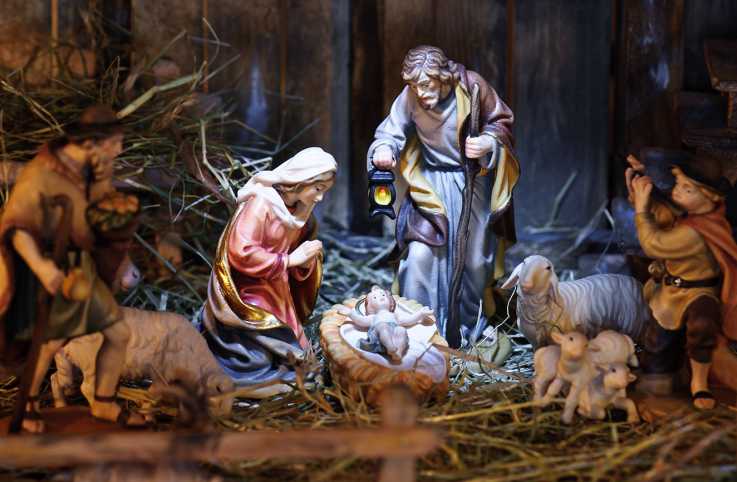
 Mary fought back the fear rising in her chest. She could feel the muscles in her back tightening uncontrollably. Frightened, she tried to recite the verses she had learned as a child. The contraction subsided, and she rested. There was cause for the fear she felt. Having never known a man, she was about to give birth to a son.
 Perhaps the best known Bible verse about trusting God is found in Proverbs 3:5. “Trust in the Lord with all your heart, and lean not on your own understanding.” Eugene Peterson rendered that verse, “Trust GOD from the bottom of your heart; don’t try to figure out everything on your own.” The anxious person tries to figure it out on his own, and he knows he doesn’t have the resources. This is especially evident when we worry about others. Our relationships with our family members is a good example. Parents are prone to worry about their children’s future. A sister worries about her brother’s drug addiction. A middle-aged woman worries about her aging parents’ failing health. When we deal with others’ choices, the outcome is outside of our control because their will is their own. We cannot make them want what they don’t want for themselves. We can instruct and discipline our children. We can grieve over our siblings’ destructive choices. We can lovingly share our concerns with our parents. But in all of these relationships, we cannot ultimately control their will. It is outside the realm of our ability; their future is outside of our field of vision. So we worry. To ultimately gain victory over this type of anxiety, you will need to acknowledge that your resources are limited and trust in the one whose resources are not.